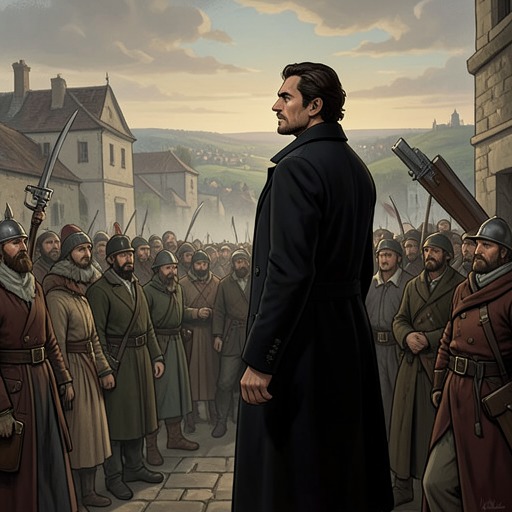
Arne Saknussemm
A Journey to the Centre of the EarthArne Saknussemm is the learned Icelandic alchemist whose encoded directions launch the expedition and whose trail across the subterranean world supplies its most consequential proof: a previous traveler has gone ahead. He never appears in person, but a sequence of inscriptions, the tool that made them, and the route they indicate make his absence an active force in the story. For Professor Hardwigg, Saknussemm is first a name to investigate, then a predecessor to honor; for Henry Lawson, his traces turn a suspected fiction into undeniable history.
Identity and Historical Clues
Professor Hardwigg identifies Saknussemm as a celebrated Icelandic scholar of the sixteenth century, a professor and alchemist. He places him among the learned figures of alchemy, invoking Avicenna, Bacon, Lully, and Paracelsus as examples of men who made remarkable discoveries. The claim first reaches the reader through the professor’s excitement, not through an independent account of Saknussemm’s life: his identity is pieced together from the surviving book and the marks he left underground.
The manuscript volume and the smaller parchment are written in different hands, and Professor Hardwigg judges the cryptogram to be later than the book. His linguistic clue is the double M in its first letter, which he says entered the Icelandic language only in the twelfth century; on that basis, he dates the parchment two hundred years after the volume. Henry Lawson regards this as plausible but still conjectural. That contrast establishes the pattern of Saknussemm’s presence in the narrative: a physical fragment invites interpretation, and Professor Hardwigg’s confidence runs ahead of Henry’s skepticism until further traces can test it.
The Cryptogram and the Expedition
The deciphered message directs an audacious traveler to descend into the crater of Yocul of Sneffels before the Kalends of July, when the shadow of Scartaris indicates the way. It promises that the route will reach the centre of the earth and closes with Saknussemm’s declaration, “I did it.” The signature changes the parchment from an anonymous puzzle into a personal testimony: its writer claims not merely to know a route, but to have traveled it.
The instructions give the expedition both a destination and a timed condition. Their reference to Scartaris’s shadow later guides the explorers in choosing the correct shaft in the crater. Saknussemm’s achievement is therefore not only an astounding claim about the earth’s interior; it is also a practical, reproducible itinerary, encoded in writing and tied to observable geography. Once Professor Hardwigg accepts the message as genuine, the old scholar’s words become the basis for a journey undertaken by Professor Hardwigg, Henry Lawson, and Hans Bjelke.
A Trail of Inscriptions and Objects
At a later stage of the descent, Professor Hardwigg finds Saknussemm’s name on the eastern face of a massive stone block. Its characters are half eaten away by time, yet the signature is still legible enough to confront Henry with the name he had treated as doubtful. The discovery moves the argument beyond the professor’s reading of a document: Saknussemm appears to have marked a point along the actual underground route.
On the shore of the subterranean sea, Henry discovers a dagger abandoned in the sand. Professor Hardwigg examines its jagged edges and the regular coating of iron rust, reasoning that it has lain there for centuries. He then connects the blade to an inscription: Saknussemm, he says, used the dagger to carve a name into the rock and to indicate the way onward. The object’s significance lies in this conjunction of tool and mark. The dagger is not simply old; it is evidence that the traveler whose initials the explorers seek was present at this shore and left a deliberate guide.
The search prompted by the dagger leads the travelers along a narrow strip of shore beneath steep rock walls. Under a huge overhanging rock, they find the entrance to a dark tunnel. Nearby, two worn initials, “A. S.,” have been cut into a square granite tablet smoothed by rubbing it with another stone. The initials identify the maker of the trail, while their position by the tunnel gives them navigational force: the inscription points toward a passage that may renew the route to the earth’s interior.
Proof, Influence, and Narrative Role
For Henry, the initials and the dagger together settle what the parchment alone could not. He had believed Saknussemm’s journey might be a myth or the invention of a fertile mind; now he is holding the very instrument used to engrave the traveler’s name in rock. The physical evidence links person, tool, inscription, and place, turning an inherited claim into a traceable history. The narrative’s proof accumulates materially: first the cryptogram, then a name carved on a great stone, then the dagger and the initials beside a tunnel.
Professor Hardwigg reads these marks as signs of exceptional care. In an impassioned address to Saknussemm, he praises the traveler for leaving no resource unused to show others a way into the globe, and imagines that Saknussemm marked each important stage of the journey so that successors could follow. He resolves to reach the centre and place his own name where Saknussemm’s trail ends. He also names the cape seen on the shore Cape Saknussemm, commemorating the predecessor who first indicated the way there.
Saknussemm’s influence also changes Henry’s response to the expedition. Seeing the three-hundred-year-old letters and recognizing the dagger as their engraving tool, he can no longer sustain his earlier disbelief without denying the evidence before him. The danger of continuing and the peril of returning recede from his attention as Professor Hardwigg’s enthusiasm catches him. Saknussemm thus functions as the absent pioneer whose material legacy converts speculation into conviction and gives the living explorers a route, a precedent, and a reason to press onward.